When people talk about Madhubani or Mithila painting, they often begin with its bold outlines, bright colour, and crowded patterns. A Kohbar painting begins somewhere more particular: with a wedding, a household, and a room prepared for the newly married couple.
The word Kohbar is closely associated with the Kohbar ghar, the wedding room in a Mithila home. Bihar Museum describes Kohbar paintings as part of wedding observances, made on walls and, in later forms, on paper or fabric. The painting belongs to a social setting. It is a blessing for a new beginning, a surface for familiar signs, and a work made to be encountered by family as well as the couple. Bihar Museum’s collection note describes one such work by Godawari Dutta, while Sahapedia’s account of Mithila rituals places Kohbar imagery within a wider cycle of wedding customs.
That context matters. A Kohbar is not simply a decorative “Madhubani pattern” that can be separated from its purpose. It is one expression of a living visual tradition, shaped by the people who make it, the household that receives it, and the occasion for which it is created.
A painting made for a room and a moment
Historically, Mithila artists painted ceremonial images on the walls of homes. In the Kohbar ghar, the artwork formed part of preparing a space for marriage. The University of California, Berkeley’s ORIAS teaching resource notes that wedding-chamber murals were made by women and that, from the 1960s, artists increasingly painted on paper. It also describes how the move to paper developed after a severe drought, as women were encouraged to sell paintings for income.
The change in surface changed how the work could travel. A wall painting belonged to a particular home and occasion; paper made it possible to preserve, carry, exhibit, and sell a painting. That shift brought Mithila art to audiences far beyond the region, while artists continued to work with subjects and forms rooted in local life. Bihar’s district handicraft overview likewise describes the movement from walls to paper, cloth, and canvas.
It is helpful to see this as expansion rather than replacement. A painting on paper can carry motifs associated with a Kohbar, but it is not the same thing as the mural made for a family’s wedding room.
Reading the motifs without turning them into a fixed code
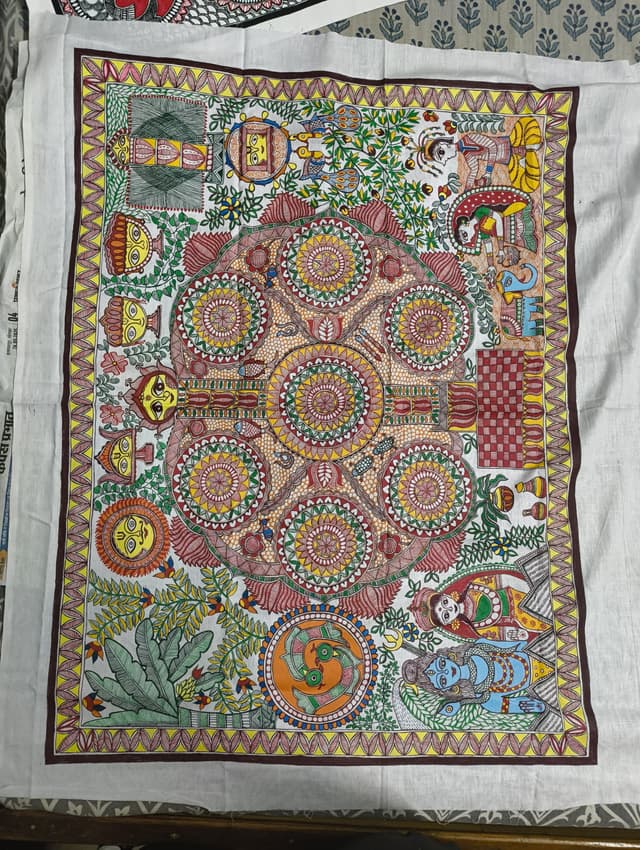
Kohbar paintings can include plants, animals, celestial bodies, protective figures, deities, and wedding scenes. The lotus and its leaves, bamboo, fish, parrots, turtles, the sun and moon, and the Navagraha appear in museum and cultural descriptions of the tradition. Together they bring fertility, continuity, protection, wellbeing, and the natural world into the picture.
Still, it is better not to treat every motif as a symbol with one permanent translation. Interpretations differ between works and communities. The Asian Art Museum’s label for Mahasundari Devi’s An auspicious diagram (kohbar) reads the central lotus and bamboo grove in relation to the bride and groom, while the Bihar Museum’s note on Godawari Dutta’s painting describes its own arrangement of figures, offerings, colour, and protective imagery. These are readings of particular paintings, not a universal legend for every Kohbar.
This is one reason to look at the composition as a whole. What sits at the centre? Which forms repeat around it? Are there paired birds, flowering plants, or figures from a story? How does the border relate to the central scene? A careful viewer starts with what the artist has painted, then uses cultural sources to understand possible associations without assuming that one explanation fits every image.
Dense pattern, close looking
Mithila painting is often built through line, repetition, and richly filled surfaces. The Bihar government’s tourism overview describes the tradition’s many working surfaces and tools, from mud walls to cloth and handmade paper, and from fingers and twigs to brushes and nib-pens. The Madhubani district administration also notes that artists use a range of materials and that contemporary practice includes both women and men.
For a Kohbar, detail is not only ornament. A close field of lines and motifs can hold multiple parts of a wedding story or an auspicious wish in one image. Spend time with the edges as well as the centre: borders may carry their own sequence, and the smaller details can change how the central scene feels.
From a wedding mural to a painting collected today
Today, Kohbar imagery can be encountered in homes, galleries, museums, and on paper. The context may be different from the one in which a particular wall mural was first made, so a contemporary artwork is best understood on its own terms rather than presented as a substitute for a family ritual.
At Janaklali, the Kohbar painting is described as a made-to-order work on handmade paper in acrylic colours, with several size options. Its product page shows an original painting photograph as well as generated room mockups; the original is clearly marked there. For a collector, the distinction is useful: the original photograph shows the artwork itself, while a mockup offers one possible sense of scale in a room.
When viewing any Kohbar painting, ask who made it, what materials they used, and what the artist says about the motifs in that specific work. Those questions keep the story connected to the person behind the painting, rather than reducing a living tradition to a list of decorative symbols.
Kohbar painting brings art into the setting of marriage and family life. Its motifs can speak of continuity and blessing, but their meaning lives in particular images and communities. Look slowly, read the room the painting came from, and let the details lead you back to the people who made it.
Sources and further reading
- Bihar Museum — Kohbar
- Asian Art Museum — An auspicious diagram (kohbar) by Mahasundari Devi
- Sahapedia — The Congruence of Tradition and Art-making in Mithila
- University of California, Berkeley, ORIAS — Mithila Painting: Folk Art of India
- Government of Bihar, Tourism Department — Madhubani or Mithila Painting
- District Administration, Madhubani — Handicraft
WRITTEN BY
Janaklali Editorial Desk
The Janaklali Editorial Desk shares stories about Mithila art, craft, and cultural heritage, drawing on museum, academic, and public sources.